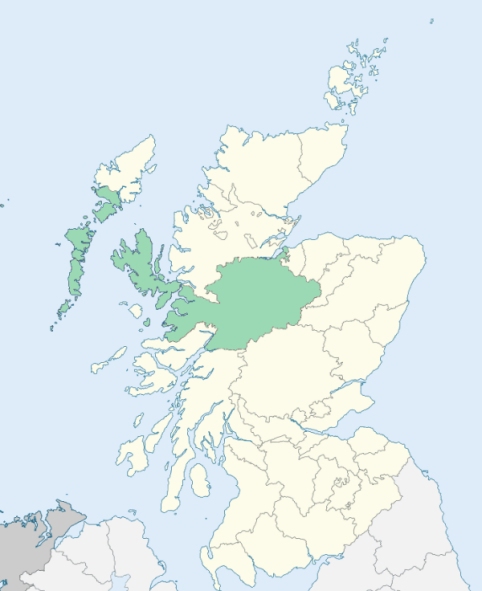
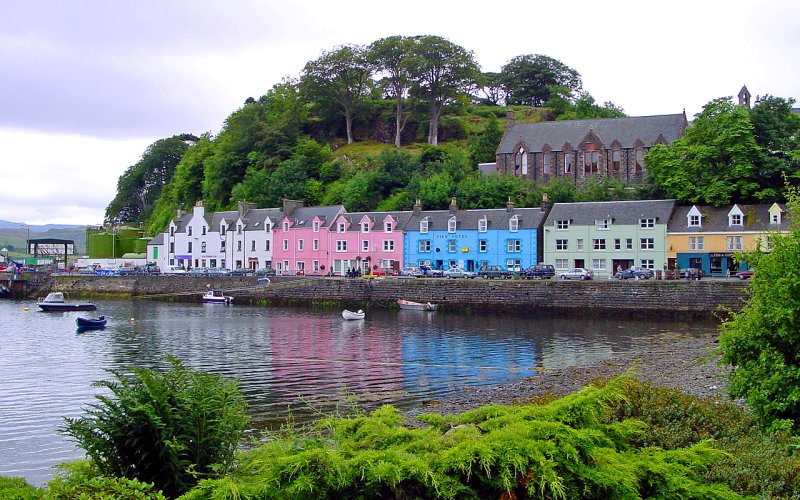
Portree is a parish in the Skye district of Inverness-shire. It comprehends the islands of Raasay and Rona, and a large district on the east coast of Skye. (1867: The Imperial Gazetteer of Scotland, by John Marius Wilson).
Arnish, Balmaqueen or Balmacqueen, Bermess, Breckry or Scorrybreac, Brochel, Brogaig, Camistinavaig, Clachan, Eyre, East Suisnish, Garifad, Glasvein, Glenmore, Greanlin, Hallaig, Harlosh, Hirbesta, Hollm, Holm, Hungladder, Inverarish, Kildonan, Kiltarlagain, Lealt, Marshadder, Mugeary, North Fearns, North Screapadal, Oskaig, Peinchorran, Penifiler, Portree, Sconser, South Fearns, South Screapadal, Suisnish, Torvaig
PRE-REFORMATION GOVERNANCE:
POST-REFORMATION GOVERNANCE:
The two parishes of Portree and Raasay were united in the sixteenth century. For a time this union included also Snizort and Uig. They were disjoined again by the Court of Teinds on 26 Feb 1726. In that year too the parish church was taken from Kiltarlagain to Portree.
Portree. The old church at Kiltarlagain was dedicated to St Tarlagan. At Portree, where the parish church now stands, there was of old a chapel of St Malrubha, and there the Saint's Fair (Feill Mhalruibh) was held. There are mission chapels within the bounds at Sconser and the Braes.
Raasay. The church of Raasay was dedicated to St Moluag. There was previously a chapel in the island of Rona.
Includes ministers, licentiates, assistants, readers, and clerks.
(1928: Fasti Ecclesiæ Scoticanæ, by Hew Scott, D. D.)
Parish registers turned over to the Registrar-General, as a result of the Registration of Births, Deaths, and Marriages (Scotland) Act of 1854. The letters B. D. and M. indicate Births (or Baptisms), Deaths (or Burials), and Marriages (or Proclamations of Banns) respectively. Numbers indicate separate volumes or books. Note: These records are by no means complete or without damage; consult the Detailed List of the Old Parochial Registers of Scotland (1872) to learn more about the condition of the records.
| OPR and RD Numbers | |||
|---|---|---|---|
| Date Range | Name | Number | Type |
| 1800-1854 | Portree | 114 | OPR |
| 1855-1857 | Portree | 114 | RD |
| 1858-1970 | Portree | 114-1 | RD |
| 1858-1970 | Raasay | 114-2 | RD |
| 1971-1971 | Portree and Raasay | 114 | RD |
| 1972-2001 | Portree | 257 | RD |
| 1972-2001 | Raasay | 258 | RD |
| 2002-2006 | Portree and Raasay | 247 | RD |
| 2009 | Highland, Portree and Raasay | 257 | RD |
| 2026 | (Portree) Highland Council; Portree and Braes Community Council | ||
| 2026 | (Raasay) Highland Council; Raasay Community Council | ||
(2009: Parishes and Registration Districts of Scotland - Old and New, National Records of Scotland)
Local community councils (2026) are provided as a potential source of additional information for settlements within the original boundaries of the parish. (Source)
Statistics from informal and official censuses
Beaton, Finlayson, Gillies, MacDonald, Mackenzie, MacKinnon, MacLeod, Matheson, Nicolson, Stewart
Note: Names appearing in research materials, other than censuses. Simple names (First name, surname only) have been omitted unless they appear associated with large properties. All women's names, and men's names with occupations, military ranks, or peerage titles are included.
By Mr Alexander Campbell, Schoolmaster, Portree.
"About 15 years ago, when the minister personally took the last list of them, the number of examinable persons in this parish were 1248, of which 930 were in Portree, and 318 in Raasay. Since that time the increase has been considerable: After the exactest inquiry, the whole number of souls appears to be 1980. The number of weavers in the parish is four; of weaveresses, 12. There are 2 blacksmiths, 5 carpenters, 8 tailors, and 3 shoe or brog-makers; but the generality of the people make their own brogues. There may be reckoned six petty merchants, besides the innkeeper of Portree, with whom it has been always customary to keep a large assortment of hardwares, grocery goods, and sundry other things necessary for the use of the country.
The language generally spoke is the Gaelic, but much corrupted with a mixture of English words, which the common people, ambitious to be thought to understand something of that language, are fond of using on every occasion. The common people are naturally endowed with a strength of mind and sprightliness of disposition that greatly distinguish them from others of the same rank and condition. Their inquisitive turn, and fondness for news, frequently induce them to address all they see for information; and their questions, and, shrewd remarks, are often very surprising. This curiosity is no where more conspicuous than in Portree, and perhaps there are few places that afford more frequent opportunities of gratifying it."
(This section contains excerpts, at times restructured or paraphrased, from an article appearing in Statistical Account of Scotland, Sir John Sinclair, 1791-1799)
Primary Sources:
Statistical Account of Scotland (1791-1799), Volume 16, p. 138
New Statistical Account of Scotland (1834-1845), Volume 14, Section I, p. 218
See Parish Page Sources for all source information and links.