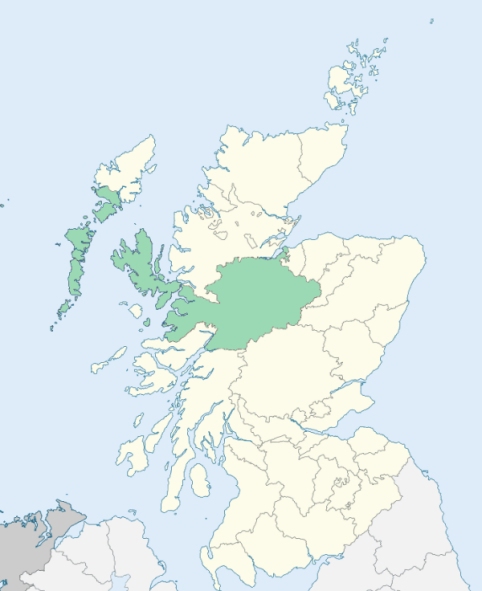
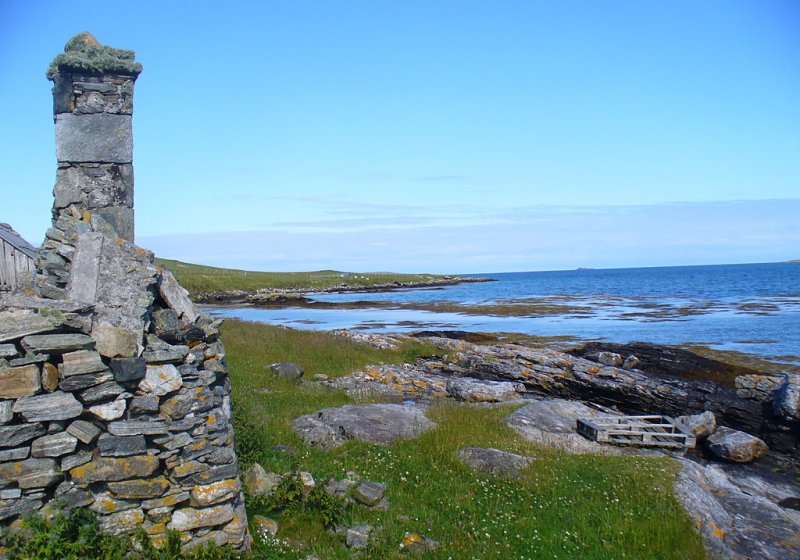
North Uist is a parish in the part of the Outer Hebrides which belongs to Inverness-shire. It comprehends the island of North Uist, a number of inhabited islands lying adjacent to North Uist or near it, and a great many neighbouring isles and islets. The principal islands, additional to North Uist itself, are Kirkibost, Illeray, Balishear, Grimsay, Vallay, and Oronsay, all connected with the island of North Uist by dry sands at low water. (1867: The Imperial Gazetteer of Scotland, by John Marius Wilson).
Balelone, Balishare, Baliochrach, Ballaglasa, Balmartin, Balranald, Baluachrach, Bayhead, Baymore, Blashaval, Carinish, Carnach, Cheese Bay, Corunna, Dunskellar, Dusary, Griminish, Hoebeg, Horisary, Hosta, Hougharry, Kallin, Kilpheder, Kirkibost, Knockintorran, Langass, Locheport, Lochmaddy, Lochportain, Malaclate, Newton, Newtonferry, Otternish, Paible, Paiblesgarry, Raikinish, Samala, Sidinish, Sollas, Sponish, Strumore, Teanamachar, Tigharry, Trumisgarry, Udal
PRE-REFORMATION GOVERNANCE:
POST-REFORMATION GOVERNANCE:
When Donald Monro, Dean of the Isles, visited North Uist prior to 1549 the island was divided into two parishes, that known locally as Kilmorie and the district of Sand. The church of Kilmorie was dedicated to the Virgin Mary. At Carinish, in the south of this parish, stand the ruins of an ancient Chapel of the Holy Trinity still bearing the name of Teampull na Trianaid. Teampull na Trianaid was founded, according to MacVurich, the historian of Clanranald, by Beathag, daughter of Somerled, Lord of the Isles, first Prioress of Iona. There were also within the bounds chapels of St Martin at Baile Mhartain, St Olaf at Kilaulay, St Ultan on the island of Vallay, St Clement's at Hosta, St Peter's at Balelone, and Teampull Chriosd at Balishare. There are mission chapels in North Uist at Balishare and Carinish.
Disjoined Quoad Sacra Parishes:
Trumisgarry, previously Sand. In or before the sixteenth century, the ancient parish of Sand was united to North Uist. Its church was dedicated to St Columba. In 1828 a parliamentary church for the district of Sand was built at Trumisgarry. On 11 June 1845 this parish was again disjoined quoad sacra from North Uist. From the site of its modern church, it was then named Trumisgarry. There is a mission chapel within the bounds at Lochmaddy.
Includes ministers, licentiates, assistants, readers, and clerks.
North Uist (QO)
Trumisgarry (QS)
(1928: Fasti Ecclesiæ Scoticanæ, by Hew Scott, D. D.)
Parish registers turned over to the Registrar-General, as a result of the Registration of Births, Deaths, and Marriages (Scotland) Act of 1854. The letters B. D. and M. indicate Births (or Baptisms), Deaths (or Burials), and Marriages (or Proclamations of Banns) respectively. Numbers indicate separate volumes or books. Note: These records are by no means complete or without damage; consult the Detailed List of the Old Parochial Registers of Scotland (1872) to learn more about the condition of the records.
| OPR and RD Numbers | |||
|---|---|---|---|
| Date Range | Name | Number | Type |
| 1821-1854 | North Uist | 113 | OPR |
| 1855-1971 | North Uist | 113 | RD |
| 1972-2006 | North Uist | 251 | RD |
| 2009 | Comhairle Nan Eilean Siar | 251 | RD |
| 2026 | Comhairle nan Eilean Siar Council; North Uist Community Council | ||
(2009: Parishes and Registration Districts of Scotland - Old and New, National Records of Scotland)
Local community councils (2026) are provided as a potential source of additional information for settlements within the original boundaries of the parish. (Source)
Statistics from informal and official censuses
Boyd, Cameron, Ferguson, MacDonald, MacLean, MacLellan, MacVicar, Morrison, Robertson, Stewart
Note: Names appearing in research materials, other than censuses. Simple names (First name, surname only) have been omitted unless they appear associated with large properties. All women's names, and men's names with occupations, military ranks, or peerage titles are included.
By the Reverend Mr Allan MacQueen.
"At present, from an exact list lately taken, the population amounts to 3218 souls, which in the opinion of the oldest people in the parish, is more than a third above what it was 30 years ago. This great increase of population is owing principally to 3 causes: 1st, the preference given by the proprietor to the small tenants; 2dly, To early marriages; and 3dly, To inoculation, which is now become so general, that the poor people, to avoid expenses, inoculate their own children with surprising success. They are all, with a very few exceptions, natives of the parish, and of the Established religion, excepting 4 of the Romish persuasion.
There are in this parish 5 smiths, 25 tailors, 23 weavers, 10 boat carpenters, 3 house carpenters, and 3 millers. There are only 2 shoemakers by profession, the people for the most part making their own shoes. There are 40 women who work at the loom. There is 1 surgeon, 1 merchant, 1 schoolmaster. There are 460 families, so that, at an average, there is nearly 7 to a family. There are 460 houses that are inhabited. There are 860 married persons, male and female: 25 widowers; 34 widows.
The sudden rise of the land-rents was certainly the original cause of emigrations from the Isle of Skye and Uist to America. Those who found a difficulty in supporting their families when the rents were low, could not be persuaded that any exertions in industry would enable them to live with any degree of comfort, when raised a third more at least. This determined several of them to look out for an asylum some where else. Copies of letters from persons who had emigrated several years before to America, to their friends at home, containing the most flattering accounts of the province of North Carolina, were circulated among them. The implicit faith given to these accounts made them resolve to desert their native country, and to encounter the dangers of crossing the Atlantic to settle in the wilds of America. From 1771 to 1775, several thousands emigrated from the western Highlands to America, among whom were more than 200 from North Uist."
(This section contains excerpts, at times restructured or paraphrased, from an article appearing in Statistical Account of Scotland, Sir John Sinclair, 1791-1799)
Primary Sources:
Statistical Account of Scotland (1791-1799), Volume 13, p. 300
New Statistical Account of Scotland (1834-1845), Volume 14, Section I, p. 159
See Parish Page Sources for all source information and links.