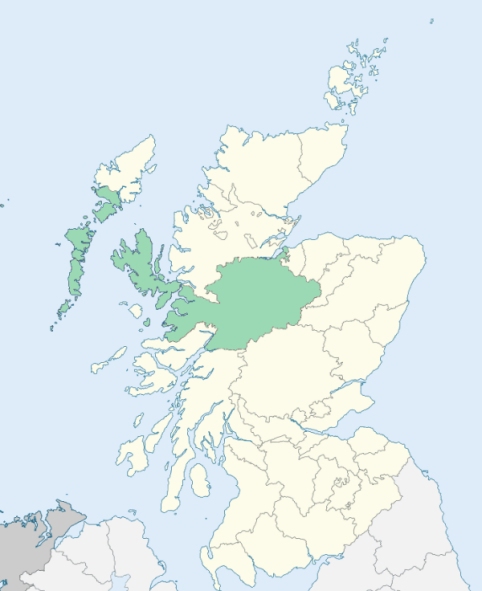
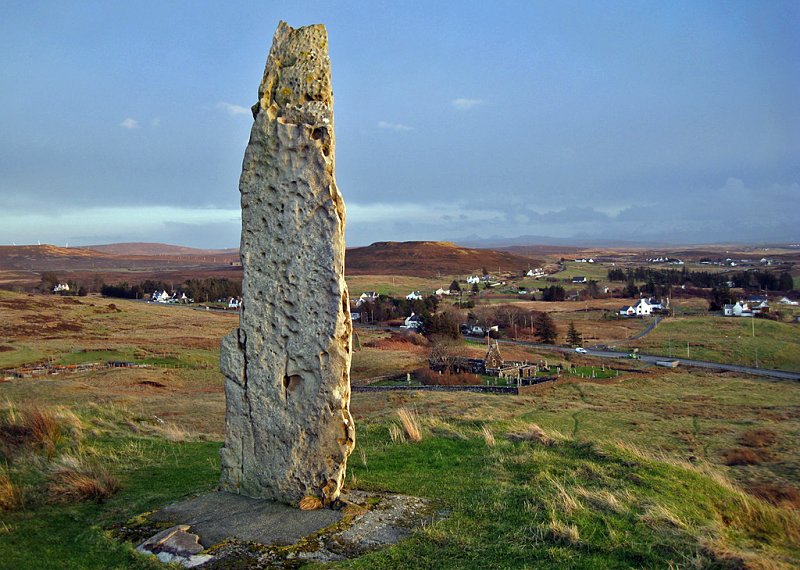
Duirinish is a parish in the south-west of Skye, Inverness-shire. It extends from the Grishernish branch of Loch Snizort on the north to Loch Bracadale on the south. It is bounded on its landward or east side by the parishes of Snizort and Bracadale. (1867: The Imperial Gazetteer of Scotland, by John Marius Wilson).
Ardmore, Balmore, Bay, Boreraig, Clagin or Claigan, Colbost, Dunvegan, Edinbain or Edinbane, Fasach, Feorlig, Geary, Glendale, Harlosh, Holmisdale, Idrigill, Kildonan, Kilmuir, Lonmore, Lorgill, Lusta, Milovaig, Ramasaig, Roag, Skinidin, Stein, Totaig, Trumpan, Uig, Uiginish, Vatten, Waterstein
PRE-REFORMATION GOVERNANCE:
POST-REFORMATION GOVERNANCE:
The church of Duirinish was dedicated to St Mary. Within the bounds there were two chapels, St Coan's at Glendale, and St Mary's at Dunvegan. At Glendale there is a Well of St Coan.
Disjoined Quoad Sacra Parishes:
Hallin-in-Waternish. A parliamentary church built here in 1828 was constituted a parish quoad sacra by the General Assembly 25 May 1833. The parish was disjoined from Duirinish by the Court of Teinds on 14 July 1847.
Includes ministers, licentiates, assistants, readers, and clerks.
Duirinish (QO)
Hallin-in-Waternish (QS)
(1928: Fasti Ecclesiæ Scoticanæ, by Hew Scott, D. D.)
Parish registers turned over to the Registrar-General, as a result of the Registration of Births, Deaths, and Marriages (Scotland) Act of 1854. The letters B. D. and M. indicate Births (or Baptisms), Deaths (or Burials), and Marriages (or Proclamations of Banns) respectively. Numbers indicate separate volumes or books. Note: These records are by no means complete or without damage; consult the Detailed List of the Old Parochial Registers of Scotland (1872) to learn more about the condition of the records.
| OPR and RD Numbers | |||
|---|---|---|---|
| Date Range | Name | Number | Type |
| 1817-1854 | Duirinish | 110 | OPR |
| 1855-1882 | Duirinish | 110 | RD |
| 1883-1970 | Duirinish | 110-1 | RD |
| 1883-1970 | Waternish | 110-2 | RD |
| 1971-1971 | Dunvegan | 110 | RD |
| 1972-2006 | Dunvegan | 256 | RD |
| 2009 | Highland Council | 256 | RD |
| 2026 | (Duirinish) Highland Council; Plockton and District Community Council | ||
| 2026 | (Waternish) Highland Council; Waternish Community Council | ||
| 2026 | (Dunvegan) Highland Council; Dunvegan and District Community Council | ||
(2009: Parishes and Registration Districts of Scotland - Old and New, National Records of Scotland)
Local community councils (2026) are provided as a potential source of additional information for settlements within the original boundaries of the parish. (Source)
Statistics from informal and official censuses
Beaton, Campbell, Ferguson, Grant, MacDonald, MacLean, MacLeod, Morrison, Shaw, Stewart
Note: Names appearing in research materials, other than censuses. Simple names (First name, surname only) have been omitted unless they appear associated with large properties. All women's names, and men's names with occupations, military ranks, or peerage titles are included.
By the Reverend Mr William Bethune.
"The population of this parish, and of the whole island, is increasing, and has been increasing for at least 80 years back. The old people affirm, that they remember lands which lay waste in several districts, not only of this parish, but in several parts of the island, for want of inhabitants to occupy them. Of late, the inhabitants have multiplied so much, that from August 1771, to October 1790, eight large transports have sailed from this island with emigrants, to seek settlements in America; the last of these transports sailed on the 6th of this month (October 1790) from Loch Bracadale.
From the year 1772 to 1775, 204 males, and 207 females, emigrated from this parish to America, exclusive of those who have gone in the two last ships; yet the population appears as great as in 1772. This increase of population may be attributed to a more judicious and rational treatment of children and women in child-bed, than was formerly observed; and above all, to the inoculation of the small-pox, which has been universally practiced in this island for 30 years past, and has been the means of preserving many lives.
In every district of the parish there are some weavers, male and female, a few tailors, a blacksmith in every barony, some boat-builders, and house-carpenters. Every farm keeps boats, the people go fishing for their own use, or when they see an appearance of herrings. There are very few bred seamen, but all expert rowers, good hardy watermen, and skilled in making a boat with sails."
(This section contains excerpts, at times restructured or paraphrased, from an article appearing in Statistical Account of Scotland, Sir John Sinclair, 1791-1799)
Primary Sources:
Statistical Account of Scotland (1791-1799), Volume 4, p. 130
New Statistical Account of Scotland (1834-1845), Volume 14, Section I, p. 322
See Parish Page Sources for all source information and links.