Petty and Brachollie
Petty is a parish on the south side of the Moray Firth, in the extreme northeast of the county of Inverness. It is bounded on the north by the parish of Ardersier; for ¼ mile at the northeast corner by the parish of Nairn; on the east and southeast by the parish of Croy; on the southwest by the parish of Inverness; and on the northwest by the Moray Firth. (1892-6: Ordnance Gazetteer of Scotland, by Francis H. Groome)
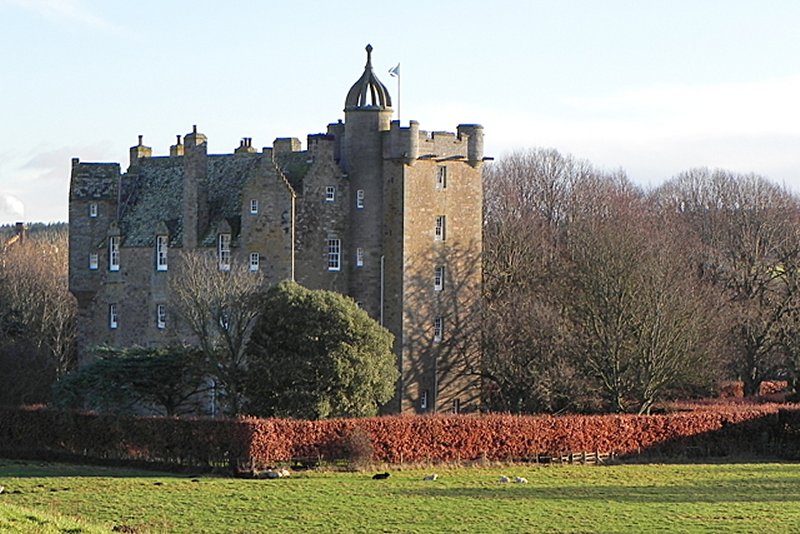
Balloch, Brackley, Campelton, Castle Stuart Connage, Culloden, Dalcross, Fisherton, Gollandfield, Petty, Stuarton, Tornagrain
Flemington
The parish of Petty was situated partly in the county of Inverness and partly in the county of Nairn. The Nairnshire portion has been transferred to Inverness-shire, the whole parish being thus placed in the latter county. See affected properties and landholders. (1892: Boundary of counties and parishes in Scotland as settled by the Boundary Commissioners under the Local Government Act, 1889, by Hay Shennan)
PRE-REFORMATION GOVERNANCE:
POST-REFORMATION GOVERNANCE:
The parishes of Petty and Brachollie were united about 1500.
Petty. The vicarage of Petty was dedicated to St Columba.
Brachollie. The church of Brachollie was dedicated to St Ewan.
Includes ministers, licentiates, assistants, readers, and clerks.
(1928: Fasti Ecclesiæ Scoticanæ, by Hew Scott, D. D.)
Parish registers turned over to the Registrar-General, as a result of the Registration of Births, Deaths, and Marriages (Scotland) Act of 1854. The letters B. D. and M. indicate Births (or Baptisms), Deaths (or Burials), and Marriages (or Proclamations of Banns) respectively. Numbers indicate separate volumes or books. Note: These records are by no means complete or without damage; consult the Detailed List of the Old Parochial Registers of Scotland (1872) to learn more about the condition of the records.
| OPR and RD Numbers | |||
|---|---|---|---|
| Date Range | Name | Number | Type |
| 1633-1854 | Petty | 106 | OPR |
| 1855-1970 | Petty | 106 | RD |
| 2009 | Highland, Inverness | 240 | RD |
| 2026 | Highland Council; Ardersier and Petty Community Council | ||
(2009: Parishes and Registration Districts of Scotland - Old and New, National Records of Scotland)
Local community councils (2026) are provided as a potential source of additional information for settlements within the original boundaries of the parish. (Source)
Statistics from informal and official censuses
Cameron, Campbell, Davidson, Fraser, Johnstone, MacDonald, MacKintosh, Munro, Ross, Smith
Note: Names appearing in research materials, other than censuses. Simple names (First name, surname only) have been omitted unless they appear associated with large properties. All women's names, and men's names with occupations, military ranks, or peerage titles are included.
By the Reverend Mr William Smith.
"There was an actual numeration made of the catechisable persons in this parish, about 16 years ago, when they amounted to about 1370. Since that time the population has diminished; for by a recent numeration for the purpose of this statement, the number of persons above 8 years old is 1302, and of children under that age is 216, in all 1518 souls.
The inhabitants of this parish are in general sober, peaceable, and industrious. Crimes of an atrocious nature are extremely rare, or rather unknown among them. Though they are far from being unsocial, but have pretty frequent convivial meetings, as at weddings and the like, yet after spending some hours cheerfully together, they separate in a peaceable and friendly manner. Drinking to excess and quarrelling are accounted reproachful, and therefore, persons addicted to these vices are avoided. They appear to be satisfied with their condition; and most of them are easy in their circumstances according to their stations, nay, some of them have even made a little money. But it must also be acknowledged, that some, from want of industry and economy, and some from misfortune, or from having very large families, are in very straitened circumstances. They are very ready, according to their abilities, to relieve the indigent and distressed, especially such as have been reduced to that condition by calamity or misfortune. They are fair and honest in their dealings, and obliging to one another.
In their manners they shew a good deal of attachment to old fashions and habits. Though, from their frequent intercourse with people that speak the English language, it might be expected that they would have acquire some knowledge of it, yet the Gaelic continues in general use among them. Most of them can speak nothing else, and the few that can speak the English do it but very imperfectly. The Highland dress is still retained by them in a great measure. The plaid is almost totally laid aside; but the small blue bonnet, the short coat, the tartan kilt and hose, and the Highland brogues are still the ordinary dress of the men. The women in like manner retain the Highland dress of their sex, but have adopted more of that of their low country neighbours than the men."
(This section contains excerpts, at times restructured or paraphrased, from an article appearing in Statistical Account of Scotland, Sir John Sinclair, 1791-1799)
Primary Sources:
Statistical Account of Scotland (1791-1799), Volume 3, p. 21
New Statistical Account of Scotland (1834-1845), Volume 14, Section I, p. 375
See Parish Page Sources for all source information and links.