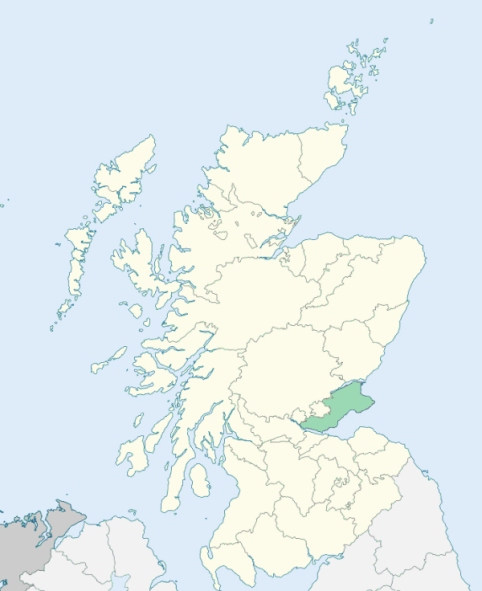
Kirkcaldy is a parish on the south coast of Fife. It is bounded by the Firth of Forth, and by the parishes of Abbotshall, Auchterderran, and Dysart. (1867: The Imperial Gazetteer of Scotland, by John Marius Wilson).
Dunnikier, Hayfield, Kirkcaldy, Port Brae, Smeaton, Templehall
Strathendry
The parish of Abbotshall had two detached parts (respectively 27 acres and 4 acres in extent), both of which were wholly surrounded by the parish of Kirkcaldy. These two detached parts were annexed to Kirkcaldy parish. See affected properties and landholders. (1892: Boundary of counties and parishes in Scotland as settled by the Boundary Commissioners under the Local Government Act, 1889, by Hay Shennan)
PRE-REFORMATION GOVERNANCE:
POST-REFORMATION GOVERNANCE:
The parish church of Kirkcaldy was dedicated to St Brice. It belonged to the Abbey of Dunfermline. The parish of Abbotshall was taken off Kirkcaldy in 1650. Within the bounds there were chapels of St Patrick, St Katherine, and St Peter.
Disjoined Quoad Sacra Parishes:
St James's. Formerly Cowan Street or Port Brae. This parish was disjoined from Kirkcaldy, 24 June 1872.
St John's. The parish was disjoined from Kirkcaldy and erected, 3 November 1916.
(1928: Fasti Ecclesiæ Scoticanæ, by Hew Scott, D. D.)
Includes ministers, licentiates, assistants, readers, and clerks.
Kirkcaldy (QO)
St James's (QS)
St John's (QS)
(1928: Fasti Ecclesiæ Scoticanæ, by Hew Scott, D. D.)
Parish registers turned over to the Registrar-General, as a result of the Registration of Births, Deaths, and Marriages (Scotland) Act of 1854. The letters B. D. and M. indicate Births (or Baptisms), Deaths (or Burials), and Marriages (or Proclamations of Banns) respectively. Numbers indicate separate volumes or books. Note: These records are by no means complete or without damage; consult the Detailed List of the Old Parochial Registers of Scotland (1872) to learn more about the condition of the records.
| OPR and RD Numbers | |||
|---|---|---|---|
| Date Range | Name | Number | Type |
| 1614-1854 | Kirkcaldy | 442 | OPR |
| 1855-1855 | Kirkcaldy Burgh | 442-1 | RD |
| 1855-1855 | Kirkcaldy Landward | 442-2 | RD |
| 1856-1874 | Kirkcaldy | 442 | RD |
| 1875-1919 | Kirkcaldy and Abbotshall | 442 | RD |
| 1920-1971 | Kirkcaldy | 442 | RD |
| 1972-2002 | Kirkcaldy | 421 | RD |
| 2003-2007 | Kirkcaldy | 421-423 | RD |
| 2009 | Fife, Kirkcaldy | 421-423 | |
| 2026 | Fife Council; Kirkcaldy East Community Council Kirkcaldy North Community Council Kirkcaldy West Community Council | ||
(2009: Parishes and Registration Districts of Scotland - Old and New, National Records of Scotland)
Local community councils (2026) are provided as a potential source of additional information for settlements within the original boundaries of the parish. (Source)
Statistics from informal and official censuses
Anderson, Beveridge, Brown, Henderson, Lawson, Robertson, Smith, Thomson, Walker, Wilson
Note: Names appearing in research materials, other than censuses. Simple names (First name, surname only) have been omitted unless they appear associated with large properties. All women's names, and men's names with occupations, military ranks, or peerage titles are included.
By the Reverend Mr Thomas Fleming.
"On the first day of January 1790, there were in the town of Kirkcaldy 646 families, containing 2607 souls; in the country part of the parish, 15 families, containing 66 souls; in the whole parish 661 families, containing 2673 souls, of whom 521 were under, and 2152 above, 8 years of age. Of those who were above that age, 908 were males, and 1244 females.
There were 36 merchants, traders, and shopkeepers, 34 seafaring men, 2 farmers who have no other employment, 5 medical men, 5 officers who have served in the navy, 4 officers who have served in the army, 11 officers of the customs and salt office, 3 officers of excise, 4 writers, 1 bookseller, 3 schoolmasters, 1 saddler, 1 candlemaker, 4 sellers of stoneware, 31 keepers of inns and licensed houses for ale and spirits, 2 brewers, 10 smiths and founders, 3 watchmakers, 19 masons and plasterers, 25 house carpenters, 7 ship carpenters, 2 coopers, 2 painters, 56 weavers, 4 stocking weavers, 4 dyers, 9 hecklers, 8 tanners and curriers, 13 shoemakers, 10 tailors, 2 salters, 1 glover, 4 butchers, 12 bakers, 4 barbers, 2 cork-cutters, 7 gardeners, 30 carters, many of whom occupy a few acres of land, 3 carriers, 61 land labourers and hired servants with families, 8 male domestic servants, 217 female domestic servants, 14 male farm servants, 3 female farm servants, 5 female teachers, 4 milliners, 3 midwives, and 9 merchant's clerks, not apprentices.
On the first of January 1790, the dissenters, taking the whole number of souls, were 595. These were divided among the different denominations of dissenters in the following proportions, viz. 304 Burgers, 206 Antiburghers, 51 Presbytery of relief, 11 Independents, 10 Episocopals, 9 Reformed Presbytery, 2 Bereans, 1 Baptist, 1 Roman Catholic.
The inhabitants of this parish seem in general to enjoy the advantages of their situation, and live comfortably. Among the upper classes, the style of living is genteel, but not luxurious or expensive. Allowing for the diversity of circumstances, all classes dress well, and are generally civil in their manners, and decent in their external deportment. Although a considerable proportion of them have been bred to the sea, there is nothing of the roughness which common opinion has attached to that profession."
(This section contains excerpts, at times restructured or paraphrased, from an article appearing in Statistical Account of Scotland, Sir John Sinclair, 1791-1799)
Primary Sources:
Statistical Account of Scotland (1791-1799), Volume 18, p. 1
New Statistical Account of Scotland (1834-1845), Volume 9, Section I, p. 740
See Parish Page Sources for all source information and links.