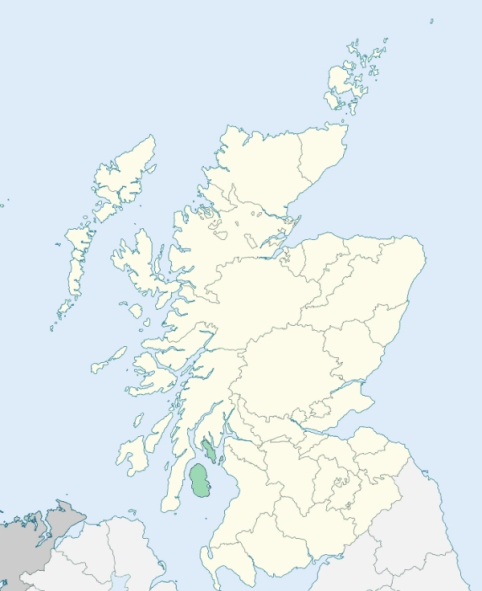
Rothesay is a parish comprehending the island of Inchmarnock and the northern and larger part of the island of Bute, in Buteshire. It is bounded on the south-east by Kingarth, and on all other sides by the Kyles of Bute and the Firth of Clyde. (1867: The Imperial Gazetteer of Scotland, by John Marius Wilson).
Rothesay
PRE-REFORMATION GOVERNANCE:
POST-REFORMATION GOVERNANCE:
The rectory of Rothesay belonged to the Abbey of Kilwinning. In early times its church was dedicated to St Brioch. A later church, built probably as early as the thirteenth century, bore the name of St Mary. In the seventeenth century this church of St Mary at Rothesay was the cathedral of the diocese of the Isles. In 1692 Rothesay Church was rebuilt mainly on its old site. In 1795 the church was again rebuilt. The parish church was renovated in 1906. Besides the parish church, Rothesay had a chapel of St Mary. On St Bride's Hill also, within the burgh, there was a chapel of St Bride. In Rothesay Castle there was a chapel of St Michael. There were also in pre-Reformation times chapels dedicated to Saints Ciaran, Finan, Colman, Columba, Constantine, Machan, and Mary. Until recent times Rothesay continued to hold a fair in honour of its patron, St Brioch. There is in the town a mission chapel for Gaelic services. It was built in 1836.
Disjoined Quoad Sacra Parishes:
Craigmore. The church was built and opened as a chapel-of-ease, 22 December 1889. The parish was disjoined from Rothesay and Kingarth, 21 February 1902.
The New Parish. A chapel-of-ease for Rothesay was built in 1798. In 1836, John, second Marquess of Bute, granted an endowment to maintain it. The parish was disjoined from Rothesay on 13 March 1871.
Includes ministers, licentiates, assistants, readers, and clerks.
Rothesay (QO)
Craigmore (QS)
The New Parish (QS)
(1928: Fasti Ecclesiæ Scoticanæ, by Hew Scott, D. D.)
Parish registers turned over to the Registrar-General, as a result of the Registration of Births, Deaths, and Marriages (Scotland) Act of 1854. The letters B. D. and M. indicate Births (or Baptisms), Deaths (or Burials), and Marriages (or Proclamations of Banns) respectively. Numbers indicate separate volumes or books. Note: These records are by no means complete or without damage; consult the Detailed List of the Old Parochial Registers of Scotland (1872) to learn more about the condition of the records.
| OPR and RD Numbers | |||
|---|---|---|---|
| Date Range | Name | Number | Type |
| 1691-1854 | Rothesay | 558 | OPR |
| 1855-1855 | Rothesay Burgh | 558-1 | RD |
| 1855-1855 | Rothesay Landward | 558-2 | RD |
| 1856-1966 | Rothesay | 558 | RD |
| 1967-1971 | Rothesay, Isle of Bute | 558 | RD |
| 1972-2006 | Isle of Bute | 550 | RD |
| 2007 | Isle of Bute, Argyll and Bute | 550 | RD |
| 2009 | Argyll and Bute Council; Isle of Bute | 550 | RD |
| 2026 | Argyll and Bute Council; Bute Community Council | ||
(2009: Parishes and Registration Districts of Scotland - Old and New, National Records of Scotland)
Local community councils (2026) are provided as a potential source of additional information for settlements within the original boundaries of the parish. (Source)
Statistics from informal and official censuses
Black, Brown, Campbell, Duncan, Ferguson, Miller, Morrison, Smith, Stewart, Wilson
Note: Names appearing in research materials, other than censuses. Simple names (First name, surname only) have been omitted unless they appear associated with large properties. All women's names, and men's names with occupations, military ranks, or peerage titles are included.
By the Reverend Mr Archibald M'Lea.
"The number of souls in the parish in 1790 were 1425 in the country, 2607 in the town, 4032 in all. The language principally spoken in the parish is the Gaelic. There is a cotton spinning mill erected in the town, which employs about 300 hands, young and old. Many, both young and old, are also employed in spinning, and in making and mending nets. The people are particularly fond of a seafaring life.
The people enjoy, in a considerable degree, the comforts and advantages of society, and seem contented with their situation and circumstances."
(This section contains excerpts, at times restructured or paraphrased, from an article appearing in Statistical Account of Scotland, Sir John Sinclair, 1791-1799)
Primary Sources:
Statistical Account of Scotland (1791-1799), Volume 1, p. 301
New Statistical Account of Scotland (1834-1845), Volume 5, Section II, p. 95
See Parish Page Sources for all source information and links.