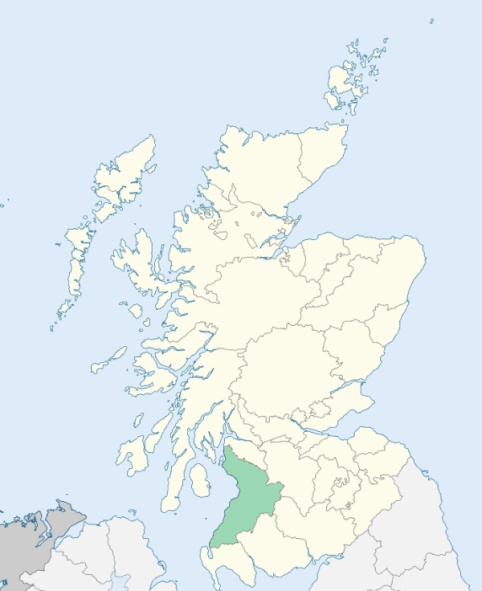
Ardrossan is a parish in the district of Cunningham, Ayrshire. It is bounded on the south-west by the Firth of Clyde, and on the other sides by the parishes of West Kilbride, Dalry, Kilwinning, and Stevenston. (1867: The Imperial Gazetteer of Scotland, by John Marius Wilson).
Ardrossan, Saltcoats
Kirkhall
The parish of Ardrossan was situated partly in the county of Ayr and partly in the county of Bute, the Buteshire portion being the island of Little Cumbrae. No change has been made on the county boundary, but the Buteshire part of the parish of Ardrossan has been transferred to the Buteshire parish of Cumbrae. See affected properties and landholders. (1892: Boundary of counties and parishes in Scotland as settled by the Boundary Commissioners under the Local Government Act, 1889, by Hay Shennan)
PRE-REFORMATION GOVERNANCE:
POST-REFORMATION GOVERNANCE:
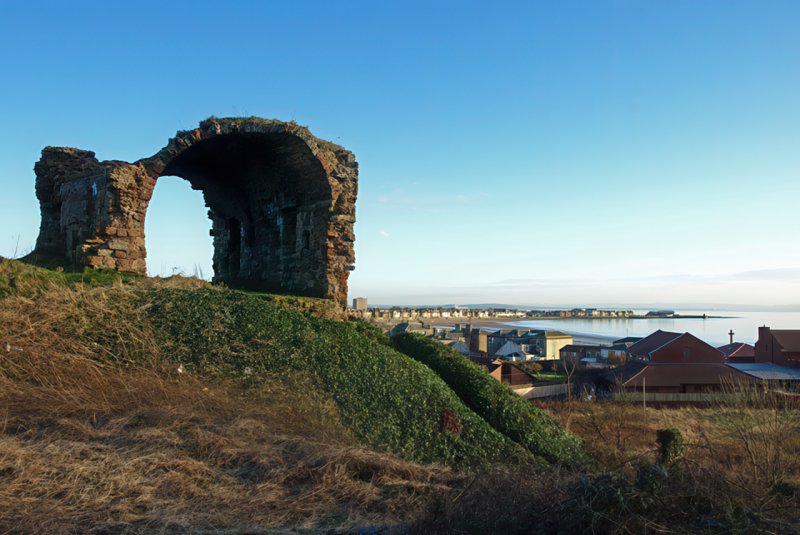
The old churchyard lies open to the wind on the Castle Hill of Ardrossan. The church there was blown down by a violent gale in 1695. A new church was then built a half a mile inland in a less exposed situation. In 1744 this latter sites was exchanged for one at the rising town of Saltcoats. The new building there fared little better from the western blasts than the old one at Ardrossan. In 1773 it was so much damaged by a wild storm of wind that it had to be rebuilt next year. A new church was erected in 1907. At Saltcoats, in earlier times, there was a chapel of St Medan. Two fairs in the year were held at Saltcoats, one on St Laurence's Day, 10th August, the other on the Nativity of St Mary, 8th Sept.
Disjoined Quoad Sacra Parishes:
New Parish. A church was built here on a site granted by Archibald, Earl of Eglinton and Winton, and largely at his expense. The parish was disjoined from Ardrossan and West Kilbride, 5 March 1851.
North Church, Saltcoats. A church built here was constituted as a Gaelic chapel by Act of Assembly, 9 May 1837. From 1843 until 6 August 1872 the chapel appears to have been closed. The Presbytery then sanctioned that it should be reopened as an English charge. On 14 December 1906 it was disjoined from Ardrossan and Stewarton.
West Dalry. The parish was disjoined from the parishes of Dalry, Kilwinning, and Ardrossan on 30 Oct 1896.
Includes ministers, licentiates, assistants, readers, and clerks.
Ardrossan (QO)
New Parish (QS)
North Church, Saltcoats (QS)
West Dalry (QS)
(1928: Fasti Ecclesiæ Scoticanæ, by Hew Scott, D. D.)
Parish registers turned over to the Registrar-General, as a result of the Registration of Births, Deaths, and Marriages (Scotland) Act of 1854. The letters B. D. and M. indicate Births (or Baptisms), Deaths (or Burials), and Marriages (or Proclamations of Banns) respectively. Numbers indicate separate volumes or books. Note: These records are by no means complete or without damage; consult the Detailed List of the Old Parochial Registers of Scotland (1872) to learn more about the condition of the records.
| OPR and RD Numbers | |||
|---|---|---|---|
| Date Range | Name | Number | Type |
| 1734-1854 | Ardrossan | 576 | OPR |
| 1855-1880 | Ardrossan | 576 | RD |
| 1861-1938 | Old Ardrossan | 576-1 | RD |
| 1861-1939 | New Ardrossan | 576-2 | RD |
| 1928-1942 | Ardrossan | 576-1 | RD |
| 1939-1942 | Saltcoats | 576-2 | RD |
| 1943-1968 | Ardrossan and Saltcoats | 576 | RD |
| 1969-1971 | Saltcoats | 576 | RD |
| 1972-2004 | Saltcoats | 662 | RD |
| 2005-2008 | Saltcoats, North Ayrshire | 662 | RD |
| 2009 | North Aryshire, Saltcoats | 662 | RD |
| 2026 | (Ardrossan) North Ayrshire Council; Ardrossan Community Council | ||
| 2026 | (Saltcoats) North Ayrshire Council; Saltcoats Community Council | ||
(2009: Parishes and Registration Districts of Scotland - Old and New, National Records of Scotland)
Local community councils (2026) are provided as a potential source of additional information for settlements within the original boundaries of the parish. (Source)
Statistics from informal and official censuses
Ardrossan: Anderson, Boyd, Brown, Crawford, Kerr, Miller, Robertson, Smith, Stewart, Thomson
New Ardrossan: Blue, Bradford, Brown, Campbell, Ferguson, Graham, Grant, Hodgson, Kerr, Nelson
West Ardrossan: Burns, Caldwell, Crawford, Hogarth, Johnstone, Robertson, Stevenson, Wakefield, Welsh, Wyllie
Note: Names appearing in research materials, other than censuses. Simple names (First name, surname only) have been omitted unless they appear associated with large properties. All women's names, and men's names with occupations, military ranks, or peerage titles are included.
By the Reverend Mr John Duncan.
"The country part of the parish, especially towards the coast, is thinly inhabited. Farms of considerable extent are only used for pasture, and some of them rented by persons who reside at a distance. The farm-houses which are inhabited amount to 31, (besides 2 or 3 that are uninhabited.) These are occupied by 219 persons, old and young, viz. 31 fathers, heads of families, 29 wives and widows, 23 sons above the age of 16 years, 24 below that age, 27 daughters above the age of 16 years, 26 below that age, 31 male, and 28 female servants of different ages. There are besides, in the country part of the parish, a few subtenants, herds, and cottagers, whose families amount to 105 persons, viz. 20 fathers, heads of families, 23 wives and widows, 4 sons above the age of 16 years, 20 below that age, 13 daughters above 16 years, 22 below that age, besides, 3 female servants. Total amount of the country part of the parish, 324 persons, old and young.
Of that part of the town of Saltcoats which stands in the parish of Ardrossan, there are 230 houses. These are occupied by 216 fathers, heads of families, 254 wives and widows, 150 sons above the age of 16 years, 153 below that age, 176 daughters above the age of 16 years, 187 below that age, 24 journeymen and apprentices, who only occasionally reside in the parish, and 34 female servants, making in whole 1194 persons. This, added to the number in the country, makes the whole amount to 1518 persons.
The Ardrossan side of the town of Saltcoats is chiefly inhabited by sailors, ship-carpenters, and weavers. Of the last, besides those employed in working the staples of the country, near 90 are employed in the silk and cotton branches by the Glasgow and Paisley manufacturers.
The inhabitants of Saltcoats are, in general, sober and industrious. Perhaps no seaport town in Scotland is more so. In the whole parish of Ardrossan there are only five public-houses, most of which are indifferently frequented, and none licensed to deal in foreign liquors. Drunken riots happen very rarely even among the lower orders of the people. In sobriety and regularity, the better sort are truly exemplary."
(This section contains excerpts, at times restructured or paraphrased, from an article appearing in Statistical Account of Scotland, Sir John Sinclair, 1791-1799)
Primary Sources:
Statistical Account of Scotland (1791-1799), Volume 7, p. 42
New Statistical Account of Scotland (1834-1845), Volume 5, Section I, p. 191
See Parish Page Sources for all source information and links.