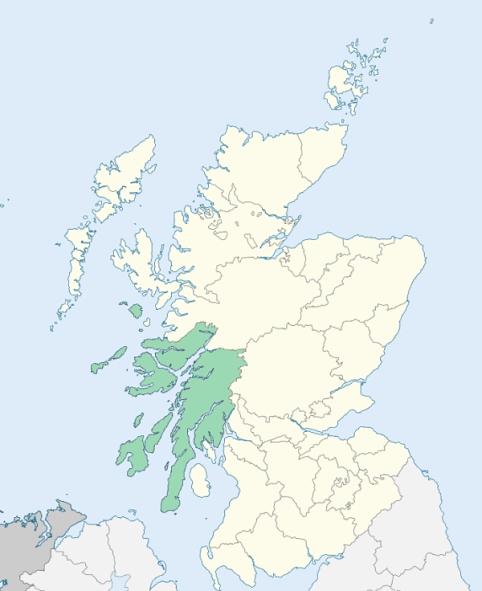
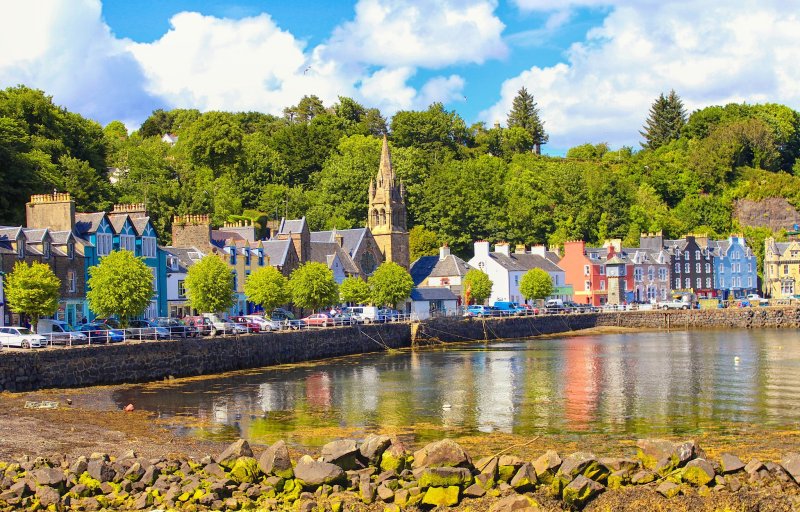
Tobermory is a seaport village in the north of Mull island, Argyllshire. It stands at the head of a sheltered bay, on the southwest side, and toward the northwestern entrance of the Sound of Mull. (1892-6: Ordnance Gazetteer of Scotland, by Francis H. Groome)
Aros, Ballochvoy, Tobermory
PRE-REFORMATION GOVERNANCE:
POST-REFORMATION GOVERNANCE:
A parliamentary chapel was built here in 1828. On 11 June 1845 the parish of Tobermory was disjoined from Kilmore. Tobar Morie, the Well of St Mary, has given its name to the parish.
Includes ministers, licentiates, assistants, readers, and clerks.
(1928: Fasti Ecclesiæ Scoticanæ, by Hew Scott, D. D.)
Parish registers turned over to the Registrar-General, as a result of the Registration of Births, Deaths, and Marriages (Scotland) Act of 1854. The letters B. D. and M. indicate Births (or Baptisms), Deaths (or Burials), and Marriages (or Proclamations of Banns) respectively. Numbers indicate separate volumes or books. Note: These records are by no means complete or without damage; consult the Detailed List of the Old Parochial Registers of Scotland (1872) to learn more about the condition of the records.
| OPR and RD Numbers | |||
|---|---|---|---|
| Date Range | Name | Number | Type |
| 1830-1854 | Tobermory | 549 | OPR |
| 1855-1971 | Tobermory | 549 | RD |
| 1972-2006 | Tobermory | 542 | RD |
| 2009 | Argyll and Bute, Tobermory | 542 | RD |
| 2026 | Argyll and Bute Council; Mull Community Council | ||
(2009: Parishes and Registration Districts of Scotland - Old and New, National Records of Scotland)
Local community councils (2026) are provided as a potential source of additional information for settlements within the original boundaries of the parish. (Source)
Statistics from informal and official censuses
Beaton, Campbell, Cochran, Hamilton, Hughes, Jones, Morrison, Owen, Roberts, Sinclair
Note: Names appearing in research materials, other than censuses. Simple names (First name, surname only) have been omitted unless they appear associated with large properties. All women's names, and men's names with occupations, military ranks, or peerage titles are included.
By the Reverend Mr Archibald M'Arthur.
"The village of Tobermory consists of 15 houses, built with stone and lime, 2 stories in height, with slated roofs, and of between 20 and 30 thatched houses, 1 story high; the population is about 300 souls. In this village are a few people, who follow the mercantile line, and serve the settlers and neighbouring districts in goods imported from the Low Country. A boat-builder also, and a cooper, have settled there, and find pretty constant employment in the building of boats, and making of barrels for the fishery. There are, of other crafts, 1 smith, 1 wright, 2 tailors, 2 shoemakers and 3 or 4 small innkeepers; also a corn mill."
(This section contains excerpts, at times restructured or paraphrased, from an article appearing in Statistical Account of Scotland, Sir John Sinclair, 1791-1799)
See Parish Page Sources for all source information and links.